
Mortgage Closing Guide
How to Read a Mortgage Closing Disclosure
Your Mortgage Closing Disclosure is the five-page document that summarizes the final terms, projected payments, closing costs and cash needed to complete your home loan. Reviewing it carefully before closing can help you identify unexpected changes, ask informed questions and arrive at the closing table with greater confidence.
For most covered mortgage transactions, you must receive the Closing Disclosure at least three business days before consummation. Use that review period to compare the disclosure with your most recent Loan Estimate and confirm that the loan reflects what you discussed with your lender.
This guide explains what appears on each of the five pages, what numbers deserve the closest attention and what to do if something appears incorrect.
Important: The Closing Disclosure is an important mortgage document, but this guide is educational and does not replace legal, tax or financial advice. Contact your loan officer, settlement agent or qualified adviser about questions involving your transaction.
What Is a Mortgage Closing Disclosure?
A Closing Disclosure is a standardized five-page form that provides important information about a mortgage loan before closing. It shows the final or near-final loan terms, estimated monthly payment, itemized loan costs, other closing expenses and the amount of money the borrower is expected to bring to closing.
The form is used for most closed-end consumer mortgages, including many home-purchase and refinance transactions. Some types of financing may use different disclosures.
The Closing Disclosure helps you review:
- The loan amount
- The interest rate
- The loan term and product
- The monthly principal-and-interest payment
- Mortgage insurance, when applicable
- Estimated property taxes and homeowners insurance
- Origination and third-party charges
- Prepaid expenses and escrow deposits
- Seller credits and other transaction adjustments
- The estimated cash required at closing
- Annual Percentage Rate and other loan calculations
You should read all five pages, even when the first page appears to match what you expected. Important information about fees, escrow, late payments, loan servicing and long-term borrowing costs appears on later pages.
The Closing Disclosure is one of the final steps in the mortgage loan process. It should be reviewed before you sign the final promissory note, deed of trust or mortgage and other closing documents.
Why the Closing Disclosure Matters
A mortgage is a long-term financial commitment. The Closing Disclosure gives you an opportunity to confirm that the loan you are about to close is consistent with the terms and costs you expected.
A careful review may help you identify:
- An incorrect borrower name or property address
- An unexpected loan amount
- A different interest rate or loan product
- Discount points you did not expect
- Missing lender or seller credits
- An incorrect earnest-money deposit
- Unexpected title, recording or settlement fees
- An inaccurate homeowners insurance amount
- Incorrect property-tax or escrow figures
- A cash-to-close amount that differs from your expectations
Finding a difference does not automatically mean an error occurred. Some costs can legitimately change as the transaction develops. However, you should ask your lender or settlement agent to explain every material difference before closing.
Closing Disclosure vs. Loan Estimate
The Loan Estimate and Closing Disclosure present similar information at different stages of the mortgage process.
The Loan Estimate is provided near the beginning of the application process and contains estimated terms and costs. The Closing Disclosure is provided near the end and reflects the final or near-final transaction.
| Loan Estimate | Closing Disclosure |
|---|---|
| Provided early in the mortgage process | Provided shortly before closing |
| Shows estimated loan terms and costs | Shows final or near-final loan terms and costs |
| Helps you compare lenders and loan offers | Helps you confirm the loan before closing |
| May be revised when permitted circumstances occur | May be corrected when final transaction details change |
| Includes estimated cash to close | Provides a more complete final cash-to-close calculation |
How to Compare the Two Forms
Place your most recent Loan Estimate beside your Closing Disclosure and compare the forms section by section.
Pay particular attention to:
- Loan amount
- Interest rate
- Monthly principal and interest
- Prepayment penalty
- Balloon payment
- Mortgage insurance
- Origination charges
- Discount points
- Lender credits
- Third-party service fees
- Cash to close
Some differences may result from final invoices, prorations, insurance premiums, recording charges, a rate-lock decision, a changed loan amount or another permitted change. Ask for a clear explanation when a figure differs materially from the Loan Estimate.
How the Closing Disclosure Three-Business-Day Rule Works
For most covered mortgage transactions, the borrower must receive the initial Closing Disclosure at least three business days before consummation.
Consummation generally occurs when the borrower becomes contractually obligated on the credit transaction under applicable state law. It may occur at the same time as the real estate closing, but the precise legal meaning can depend on the transaction and state law.
The Waiting Period Is Based on Receipt
The federal review period is based on when the borrower receives the Closing Disclosure. A signature may be used by a lender to acknowledge or document receipt, but the rule should not be understood as requiring every borrower to sign the Closing Disclosure three days before closing to begin the waiting period.
Signing an acknowledgment of receipt also does not, by itself, necessarily mean that you have accepted the mortgage or are obligated to complete the transaction.
What Counts as a Business Day?
For this waiting-period calculation, business days generally include Saturdays. Sundays and federal legal public holidays are generally excluded.
Timing matters: Electronic, in-person and mailed delivery may be treated differently. When a disclosure is mailed or delivered without evidence of earlier receipt, timing rules may presume receipt after a specified period. Your lender and settlement team should establish the disclosure deadline for your scheduled closing.
Example Review Periods
Assuming the disclosure is received on the date shown and no federal holiday affects the calculation:
| Closing Day | Closing Disclosure Generally Received By |
|---|---|
| Friday | Tuesday |
| Monday | Thursday |
| Tuesday | Friday |
| Wednesday | Saturday |
These examples are simplified. Federal holidays, delivery method, documented receipt and transaction-specific circumstances can affect the actual deadline.
Do Changes to the Closing Disclosure Restart the Waiting Period?
Most corrections to a Closing Disclosure do not require a completely new three-business-day review period. The lender may provide an updated disclosure before or at consummation, depending on the type and timing of the correction.
A new three-business-day waiting period is generally required when one of the following occurs before consummation:
- The disclosed APR becomes inaccurate.
- The loan product changes. For example, the transaction changes from a fixed-rate loan to an adjustable-rate mortgage.
- A prepayment penalty is added.
Changes such as a revised property-tax amount, seller credit, recording charge, inspection-related adjustment or another corrected cost generally do not automatically create a new three-business-day waiting period, although a corrected Closing Disclosure may still be required.
Do not assume a correction will or will not delay closing. Contact your loan officer and settlement agent immediately when a material change appears.
Page 1 of the Closing Disclosure: Loan Terms and Payment
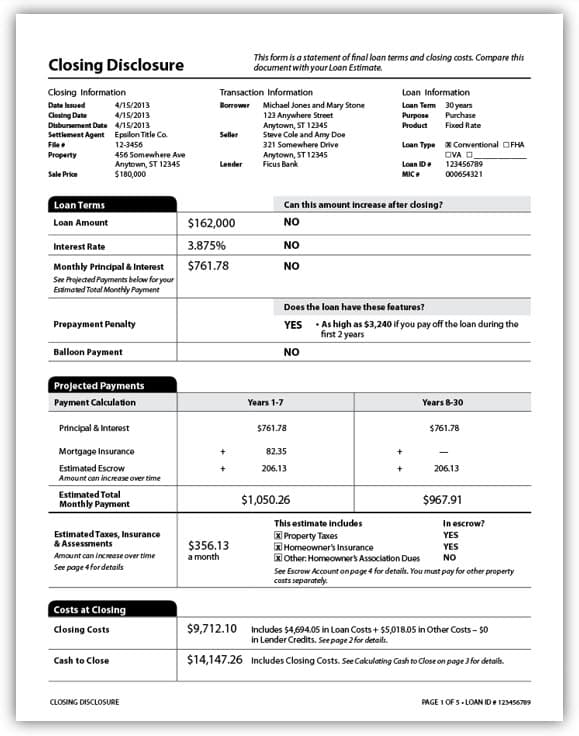
Page 1 provides a high-level summary of the transaction. Review the property address, loan term, purpose, product, loan type and identification details at the top before examining the financial terms.
Loan Terms
Loan Amount
The loan amount is the principal amount being financed. Confirm that it matches the amount you expected after accounting for the down payment and any financed costs.
Interest Rate
This is the note rate applied to the unpaid principal balance. Confirm that it matches your rate-lock agreement or other written loan terms.
You can review market information on the Kansas City mortgage rates page, but the rate on your Closing Disclosure is specific to your transaction.
Monthly Principal and Interest
This is the scheduled monthly amount applied to principal and interest. It does not include property taxes, homeowners insurance, mortgage insurance, association dues or other housing expenses.
Prepayment Penalty
This section states whether the mortgage contains a charge that could apply if all or part of the loan is paid off early under the circumstances described.
Balloon Payment
A balloon payment is a large lump-sum payment that may be due at the end of or during the loan term. Confirm that the answer shown is consistent with the loan product you selected.
Projected Payments
This section estimates how the monthly payment may be structured during different periods of the loan.
It may include:
- Principal and interest
- Mortgage insurance
- Estimated escrow
- The estimated total monthly payment
For an adjustable-rate loan or another product with changing payments, this section may display separate payment periods and possible changes.
Estimated Taxes, Insurance and Assessments
This area estimates property taxes, homeowners insurance and certain other property expenses. It also indicates which expenses are expected to be paid through escrow.
HOA dues or other property expenses may not be included in the mortgage payment even when they appear in the estimate. Make sure you understand which bills you must pay separately.
Costs at Closing
The bottom of Page 1 summarizes:
- Closing Costs: The estimated total of loan costs, other costs and lender credits.
- Cash to Close: The estimated amount the borrower must provide to complete the transaction.
Pages 2 and 3 provide the detailed calculations behind these totals.
Page 2 of the Closing Disclosure: Loan Costs and Other Costs
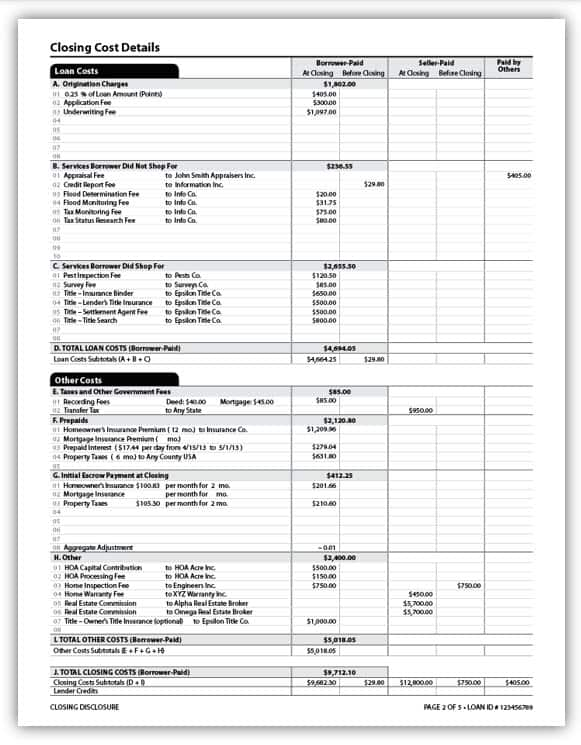
Page 2 itemizes the charges connected with the mortgage and real estate transaction.
Section A: Origination Charges
Origination charges are fees imposed by the lender or mortgage broker for making or arranging the loan. Depending on the transaction, this section may include:
- Origination charges
- Underwriting charges
- Processing charges
- Discount points
Discount Points
Discount points are upfront charges paid in exchange for a particular interest rate. One point equals 1% of the loan amount, but paying one point does not guarantee a specific reduction in rate.
Learn more in our guide to mortgage points.
Confirm that any points shown are consistent with your rate-lock decision and written loan terms.
Section B: Services Borrower Did Not Shop For
These are required services for which the borrower did not select the provider. Depending on the loan, examples may include:
- Appraisal
- Credit report
- Flood determination
- Tax monitoring or tax-status service
- Mortgage insurance-related services
Section C: Services Borrower Did Shop For
These are required third-party services for which the borrower was permitted to choose the provider.
They may include:
- Title search
- Lender’s title insurance
- Settlement or closing services
- Survey
- Pest inspection
- Other property-related services
Section E: Taxes and Other Government Fees
This section may include recording charges and transfer-related taxes. The charges depend on the property location and transaction.
Section F: Prepaids
Prepaids are amounts paid in advance at closing rather than lender fees.
They may include:
- Homeowners insurance premium
- Mortgage insurance premium
- Prepaid interest
- Property taxes
Prepaid interest generally covers interest accruing between the closing date and the beginning of the first full mortgage-payment cycle.
Section G: Initial Escrow Payment at Closing
When the mortgage includes an escrow account, this section shows the initial amounts collected to establish it.
The initial escrow deposit may include reserves for:
- Homeowners insurance
- Property taxes
- Mortgage insurance
- Other escrowed property expenses
Escrow deposits are not the same as prepaid charges, even though both may be collected at closing.
Section H: Other
This section may include transaction expenses that do not appear elsewhere, such as:
- Owner’s title insurance
- HOA-related charges
- Home warranty
- Real estate commissions when shown on the borrower’s disclosure
- Other contract or settlement expenses
Lender Credits
Lender credits reduce the amount of closing costs paid directly by the borrower. They may be connected with the selected interest rate or another pricing arrangement.
Confirm that every expected lender credit appears and that the amount is correct.
Page 3 of the Closing Disclosure: Cash to Close and Transaction Summary
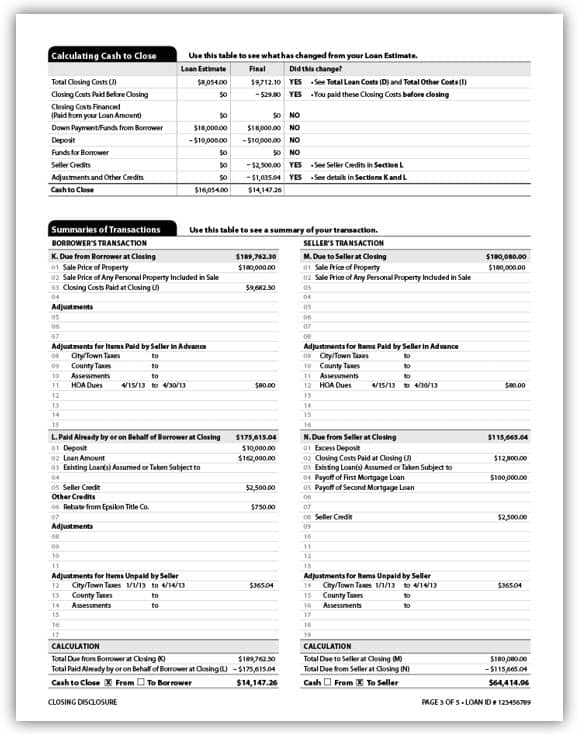
Calculating Cash to Close
This table compares figures from the Loan Estimate with the final or near-final figures used to calculate the amount due from the borrower.
Items may include:
- Total closing costs
- Closing costs financed into the loan
- Down payment or funds from the borrower
- Deposit already paid
- Funds for the borrower
- Seller credits
- Other adjustments and credits
- Final cash to close
Deposit
The deposit line generally reflects earnest money or another deposit already credited toward the purchase. Confirm that the amount matches the transaction records.
Seller Credits
Seller credits may be used toward eligible closing costs, subject to the purchase contract, loan guidelines and transaction terms. Confirm that the negotiated credit appears correctly.
Cash to Close
Cash to close is not necessarily the same as closing costs. It may include the down payment and other amounts due, less deposits, credits and other adjustments.
Review our guide to mortgage closing costs for a more detailed explanation of common expenses.
Summaries of Transactions
For purchase transactions, this section provides a summary of amounts due from and paid by the borrower and seller.
The borrower’s column may include:
- Sale price
- Closing costs paid at closing
- Adjustments for taxes or assessments
- Deposit and loan amount
- Seller credits
- Other credits
The seller’s column may include the sale price, seller closing costs, mortgage payoffs, credits and other adjustments.
Review tax, HOA and assessment prorations carefully. These figures can affect the final amount due even when the loan terms have not changed.
Page 4 of the Closing Disclosure: Additional Loan Information
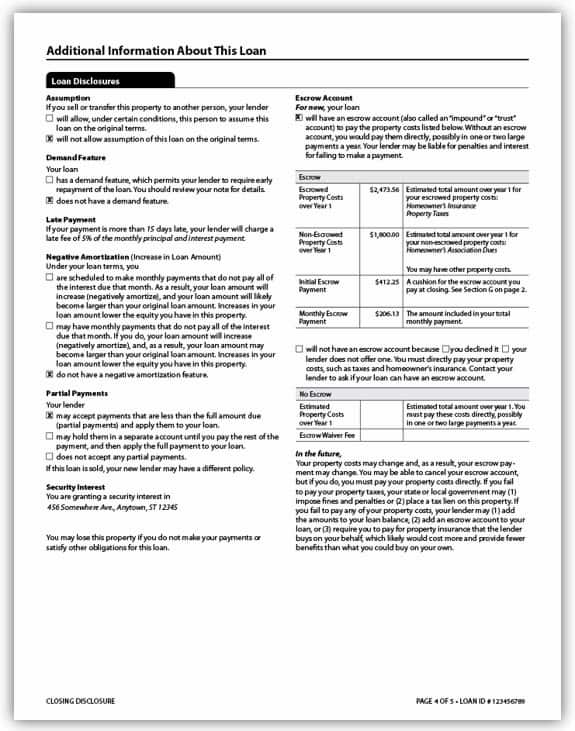
Page 4 explains additional contractual and servicing features of the mortgage.
Assumption
This section indicates whether a future purchaser may be permitted to assume the mortgage on its existing terms.
An assumable loan is not automatically transferable. The future buyer generally must satisfy the applicable loan and servicer requirements.
Demand Feature
This section indicates whether the loan contains a feature permitting the lender to require early repayment under the stated terms.
Ask for an explanation before closing if the disclosure indicates that a demand feature applies.
Late Payment
This section states when a late charge may apply and how the charge is calculated.
Review the promissory note and servicing information for the complete payment requirements.
Negative Amortization
Negative amortization occurs when scheduled payments are insufficient to cover the interest due, causing the loan balance to increase.
Confirm that this section is consistent with the loan product you selected.
Partial Payments
This section describes how the lender or future loan servicer may handle a payment that is less than the full amount due.
A partial payment may be applied, returned or held in a separate account until sufficient funds are received, depending on the disclosed policy and applicable requirements.
Security Interest
The mortgage gives the lender a security interest in the property identified in this section. Confirm that the address is correct.
Escrow Account
The escrow section indicates whether an escrow account will be established and identifies the property expenses expected to be paid from it.
When an escrow account is not established for certain expenses, you are responsible for paying those bills directly and on time.
Loan Servicing
This section states whether the lender intends to service the loan or transfer servicing after closing.
A servicing transfer does not ordinarily change the basic terms of the mortgage, but it changes where payments are sent and who handles account questions.
Page 5 of the Closing Disclosure: Loan Calculations and Contacts
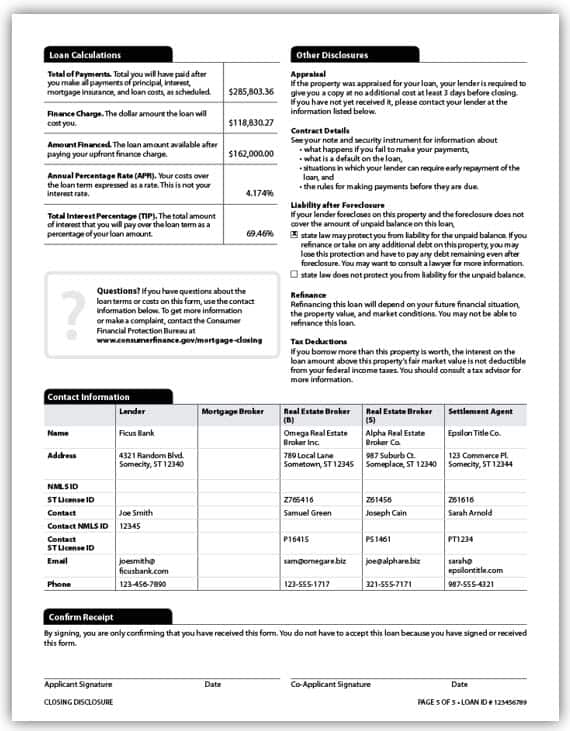
Loan Calculations
Total of Payments
This is the estimated total amount paid after making all scheduled principal, interest, mortgage insurance and applicable loan-cost payments under the disclosed assumptions.
Finance Charge
The finance charge represents the dollar amount the credit is expected to cost over the loan term under federal disclosure calculations.
Amount Financed
The amount financed is the loan amount adjusted according to federal disclosure rules for certain prepaid finance charges. It may be lower than the face amount of the mortgage and should not be confused with the cash the borrower receives.
Annual Percentage Rate
The Annual Percentage Rate, or APR, expresses the cost of credit as a yearly rate and incorporates the interest rate plus certain finance charges.
APR is not the same as the note rate. It can be useful when comparing similar loan offers, but the comparison should consider loan type, term, points, credits and how long you expect to retain the mortgage.
Total Interest Percentage
The Total Interest Percentage estimates the total interest paid over the loan term as a percentage of the loan amount, assuming all scheduled payments are made as disclosed.
Other Disclosures
Page 5 may include information about:
- Appraisal rights
- Contract details
- Liability after foreclosure
- Refinancing
- Potential tax consequences
Tax laws and individual circumstances vary. Consult a qualified tax adviser about possible deductions or tax consequences.
Contact Information
This section lists the lender, mortgage broker when applicable, real estate brokers and settlement agent involved in the transaction.
Confirm that you know whom to contact about:
- Loan terms and lender charges
- Title and settlement charges
- Real estate contract questions
- Cash-to-close instructions
- Errors or unexpected changes
Confirm Receipt
When a signature line appears, signing generally confirms receipt of the disclosure. It does not necessarily mean that you accept the loan or waive your right to ask questions.
The legal effect of later closing documents is different. Read every document presented at closing and ask questions before signing.
Which Mortgage Closing Costs Can Change?
Some charges are subject to limits on how much they may increase from the Loan Estimate to the Closing Disclosure. Other expenses may change as final figures become available.
The applicable rules depend on the type of fee, provider selection, permitted changed circumstances and other transaction details.
Charges Generally Subject to Zero Tolerance
Certain charges generally cannot increase from the amount disclosed on the Loan Estimate unless a permitted circumstance supports a revised estimate.
These may include:
- Fees paid to the creditor
- Fees paid to a mortgage broker
- Fees paid to an affiliate of the creditor or broker
- Fees for required services when the borrower was not permitted to shop
- Transfer taxes
Charges Generally Subject to a 10% Cumulative Tolerance
Certain charges may increase, but the cumulative total of the covered charges generally cannot increase by more than 10% unless a permitted change applies.
These may include:
- Recording fees
- Required third-party services when the borrower selects a provider from the lender’s written list
The 10% limitation generally applies to the combined total of covered charges, not necessarily to every individual fee.
Charges That May Change Without a Specific Tolerance Limit
Certain amounts can change because they depend on the property, closing date, provider selected or actual invoice.
Examples may include:
- Prepaid interest
- Property taxes
- Homeowners insurance
- Initial escrow deposits
- Services selected independently by the borrower outside the lender’s written provider list
- Optional services not required by the lender
Changed Circumstances
Mortgage rules permit revised estimates in certain situations. Examples may include changes requested by the borrower, changes affecting eligibility or loan terms, newly discovered property information, a delayed closing or another qualifying event.
When a charge increases, ask the lender to identify the specific reason and whether a revised Loan Estimate or other disclosure was provided.
Closing Disclosure Review Checklist
Review the following items before closing and contact your lender or settlement agent about anything unexpected.
- Borrower names: Confirm that all names are spelled correctly.
- Property address: Verify the complete address and property information.
- Loan type and term: Confirm fixed versus adjustable rate, loan program and repayment period.
- Loan amount: Confirm that the principal balance is correct.
- Interest rate: Compare it with your rate-lock agreement and most recent Loan Estimate.
- Monthly payment: Review principal, interest, mortgage insurance and escrow.
- Prepayment penalty and balloon payment: Make sure these answers match the loan you selected.
- Origination charges and points: Confirm that you understand each charge.
- Third-party fees: Compare appraisal, title, settlement and recording charges with prior estimates.
- Credits: Verify lender credits, seller credits and other negotiated credits.
- Earnest money: Confirm that the deposit is credited correctly.
- Property taxes and insurance: Check the estimates and escrow treatment.
- Cash to close: Confirm the final amount and approved payment method.
- Contact information: Know whom to call with loan, title and settlement questions.
- Wire instructions: Independently verify all instructions before transferring money.
Closing Disclosure Warning Signs to Question
Contact your loan officer or settlement agent promptly if you notice:
- A different loan product than the one selected
- An unlocked or unexpected interest rate
- A prepayment penalty you did not expect
- A balloon payment you did not expect
- Discount points you did not agree to pay
- Missing lender or seller credits
- An earnest-money deposit that is missing or incorrect
- Duplicate fees
- An unexplained increase in lender charges
- Incorrect property-tax or insurance amounts
- A large unexplained change in cash to close
- A last-minute change in wiring instructions
Do not wait until you arrive at the closing table to raise a known concern. Earlier communication gives the lender and settlement team more time to investigate and correct the disclosure when necessary.
Protect Your Closing Funds From Wire Fraud
Never rely solely on wiring instructions received by email.
Mortgage-closing scams often involve criminals impersonating a real estate agent, lender, attorney, escrow officer or title company. The message may contain convincing transaction details and instruct the buyer to send the down payment or closing funds to a fraudulent account.
Before Sending Closing Funds
- Obtain the title or settlement company’s telephone number from a trusted, independent source.
- Call that number and verbally verify the wiring instructions.
- Confirm the receiving bank, account name and account number.
- Be suspicious of urgent or last-minute changes.
- Do not use the phone number contained in a suspicious email to verify the same email.
- Ask whether a cashier’s check or another approved method is available.
- After sending a wire, confirm promptly that the correct recipient received it.
If You Suspect a Fraudulent Transfer
Contact your bank or wire-transfer provider immediately and ask whether the transfer can be stopped or recalled. Then notify the legitimate title or settlement company and report the incident to the appropriate law-enforcement authorities.
What Should You Do If the Closing Disclosure Is Wrong?
- Contact your loan officer immediately. Explain the specific term or charge you believe is incorrect.
- Contact the settlement agent when appropriate. Title, recording, tax, seller-credit and transaction adjustments may originate with the settlement team.
- Compare the document with prior records. Review your Loan Estimate, rate-lock confirmation, purchase contract, amendments, invoices and insurance quote.
- Ask for the reason in writing. Request a clear explanation of why a term or cost changed.
- Request a corrected Closing Disclosure when necessary. The lender or settlement agent can determine how the correction must be documented.
- Ask whether the change affects the closing date. Only limited categories of changes generally require a new three-business-day waiting period, but other issues can still require time to resolve.
Do not sign final loan documents until you understand the terms and are comfortable proceeding.
Mortgage Closing Disclosure FAQs
What is a Closing Disclosure?
A Closing Disclosure is a five-page form that summarizes the final or near-final terms, projected payments, mortgage costs, transaction expenses and cash to close for most covered mortgage loans.
When should I receive my Closing Disclosure?
For most covered transactions, you must receive the initial Closing Disclosure at least three business days before consummation.
Do I have to sign the Closing Disclosure three days before closing?
The federal waiting period is generally based on receipt of the disclosure, not necessarily the borrower’s signature. A lender may request an acknowledgment to document receipt.
Does signing the Closing Disclosure mean I accept the loan?
A signature acknowledging receipt generally does not, by itself, obligate you to complete the loan. The final closing documents create separate contractual obligations.
Is the Closing Disclosure final?
It reflects final or near-final loan and transaction information, but corrections can still occur before or after consummation when necessary.
Can my closing costs change after I receive the Closing Disclosure?
Yes. Some charges may change when updated information or final invoices become available. Other charges are subject to limits unless a permitted circumstance supports the change.
Does every corrected Closing Disclosure restart the three-day period?
No. A new three-business-day period is generally required only when the APR becomes inaccurate, the loan product changes or a prepayment penalty is added.
What is cash to close?
Cash to close is the amount the borrower is expected to provide to complete the transaction after accounting for the down payment, closing costs, deposits, credits, financing and other adjustments.
Are cash to close and closing costs the same?
No. Closing costs are one component of the transaction. Cash to close can also include the down payment and other amounts due, less deposits and credits.
Why is the APR higher than my interest rate?
The interest rate is used to calculate interest on the principal balance. APR includes the interest rate and certain finance charges expressed as an annual rate.
Why did my property taxes or insurance change?
Early disclosures may rely on estimates. The amount can change when property-specific tax information, insurance premiums, closing dates and escrow calculations become available.
What should I compare with my Closing Disclosure?
Compare it with your most recent Loan Estimate, rate-lock confirmation, purchase contract, amendments, insurance quote, deposit records and expected seller or lender credits.
Who prepares the Closing Disclosure?
The creditor is responsible for ensuring that the borrower receives the Closing Disclosure. The creditor and settlement agent may coordinate preparation of different portions of the form.
Can I receive the Closing Disclosure electronically?
Yes, when applicable electronic-delivery and consent requirements are satisfied. The delivery method can affect how receipt is documented and how the review period is calculated.
What happens if I do not receive it on time?
Contact your lender immediately. Consummation generally cannot occur until the required review period has been satisfied, unless a permitted waiver applies in a qualifying emergency.
Review the Official CFPB Closing Disclosure Explainer
The Consumer Financial Protection Bureau provides an interactive Closing Disclosure explainer with definitions for individual fields on the form.